
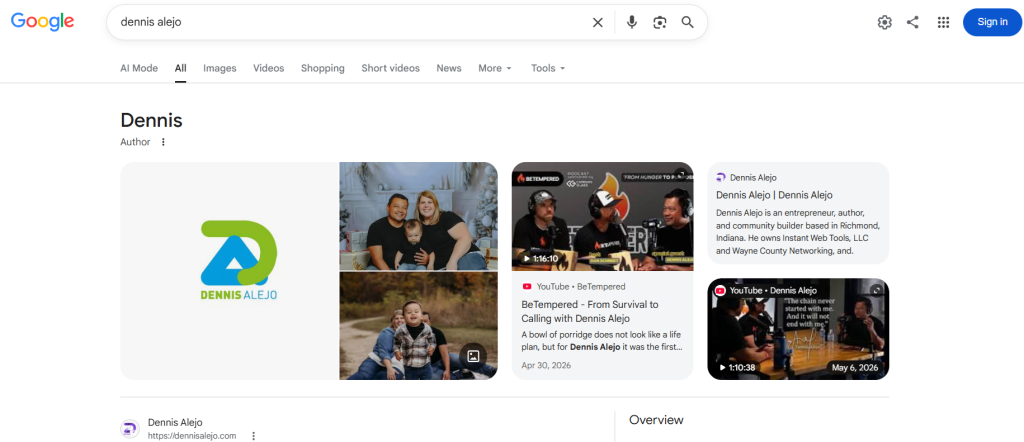
A few weeks ago, I typed my own name into Google out of curiosity. What came back wasn’t just a list of blue links — it was a full Knowledge Panel. My photo, my bio, links to my book, my podcast appearances, my businesses, all pulled together into one confident box that said, in effect, Google knows exactly who this person is.
If you’ve ever searched “how to get a Google Knowledge Panel” and landed on advice that boils down to “be famous,” this post is the answer I wish I’d found. It’s not about fame. It’s about signals — and most people never get there because they misunderstand what actually earns one.
What Is a Google Knowledge Panel, and Do You Have to Be Famous to Get One?
A Knowledge Panel is the box Google displays when it’s confident it knows exactly who — or what — you are as an entity: a person, a business, a book, a place. For people, it usually means a photo, a short bio, and links to the work, profiles, and mentions Google has connected to your name.
The question I get asked most is some version of: “Don’t you have to be a celebrity to get one of these?”
Not necessarily.
You don’t need millions of followers or a national TV spot. What you need is for Google to be able to confidently answer one question: who is this person, as an entity, and can I find enough reliable information about them across the web?
That information comes from a combination of things:
- Your website
- Your content
- Your professional presence
- Mentions and references from other sources
- A digital footprint that says the same thing everywhere it appears
Fame can generate those signals. But fame isn’t the only way to generate them. So the real question was never “Am I famous enough?” It was always: “Does Google have enough reliable signals to understand who I am?”
Why Google Knowledge Panels Are Hard to Get When You Have a Common Name
Here’s where it gets genuinely interesting. Imagine 3,000 people out there have the exact same name you do — and all 3,000 of you are, in some indirect way, asking Google for recognition.
Who does Google choose?
It has to figure out which person is actually you. Not “a person with this name” — you specifically. It does that by looking for consistency: does the name on your website match the name on your social profiles? Does your business show up connected to your name in multiple independent places? Do the mentions of you across the internet all point back to the same person, the same work, the same story?
Same name does not mean same entity. Google isn’t trying to find a Dennis, or a Sarah, or a Marcus. It’s trying to find the one specific human behind a specific body of work — and it needs enough consistent signals to make that connection with confidence.
Why One Mention Won’t Get You a Knowledge Panel
This is the part people get wrong most often. They’ll publish a great piece of content, get one nice mention, update their LinkedIn — and then wait. Nothing happens. So they conclude the whole thing doesn’t work.
But one signal is easy for Google to ignore. A single data point could be a coincidence, an outlier, a fluke. What Google is actually looking for is a pattern — the same name, the same brand, the same expertise, showing up again and again, in enough different places, over enough time, that it stops looking like chance and starts looking like identity.
You can’t post content once in a while and expect a Knowledge Panel to show up. You have to publish consistently on your own website. Share it across social media. Keep your name, your brand, your expertise, and your information the same everywhere it appears. Every inconsistency — a different bio here, an outdated title there — is friction that makes Google’s job harder.
If you’re not consistently building your digital footprint, there’s no real reason for Google to have gathered enough signals to recognize you in the first place. It’s not that Google is withholding recognition. It’s that it genuinely doesn’t have enough to go on yet.
How I Actually Got My Google Knowledge Panel
For me, this wasn’t a single campaign — it was months of unglamorous, repeated work:
- A central hub. One website, under my own name, that every other project points back to.
- Consistent publishing. Content that kept showing up, week after week, not in bursts.
- Cross-platform presence. The same name, photo, and story across social profiles, interviews, and podcast appearances.
- Third-party mentions. Other people and platforms talking about the work — which carries more weight with Google than talking about yourself ever will.
- Structured signals. Making sure the technical side (schema, consistent bios, linked profiles) matched the human side.
None of those steps are exciting on their own. Together, over time, they build a pattern Google can trust.
The Takeaway
A Knowledge Panel isn’t a prize Google hands out for being important. It’s a byproduct of being legible — of making it easy, over time, for the internet’s biggest identity-matching system to say “yes, I know exactly who this is.”
You don’t need to chase virality. You need to show up, consistently, as the same person, in the same story, over and over — until the pattern is unmistakable.
That’s the whole game: not one loud signal, but many quiet, consistent ones, pointed in the same direction.