
Search is changing. For years, getting your website found meant optimizing for Google and other traditional search engines. You focused on keywords, rankings, backlinks, content, and technical SEO.
Today, people are increasingly asking questions directly to AI-powered search platforms.
Instead of simply showing a list of ten blue links, systems such as Google AI Overviews, ChatGPT, Gemini, Perplexity, and Microsoft Copilot can interpret a question and provide an answer using information they find across the web.
That creates a new question for business owners:
How do I get my website into AI search?
There isn’t a magic button that says “Submit My Website to AI.”
Instead, you need to build a website that is:
- Discoverable
- Technically accessible
- Well organized
- Clearly written
- Structured with machine-readable information
- Supported by trustworthy signals
And this is where modern technical SEO becomes extremely important.
The Major AI Search Engines
AI search isn’t one single platform.
Today, several major platforms can provide AI-generated answers based on information from the web.
Google AI Overviews
Google can provide an AI-generated summary directly within its search results for certain queries.
ChatGPT
ChatGPT can search and use information from the web when answering questions.
Google Gemini
Gemini is Google’s AI platform and can work with information from Google’s ecosystem and the web.
Perplexity
Perplexity is designed around AI-powered research and answers, often providing citations to supporting sources.
Microsoft Copilot
Microsoft’s Copilot ecosystem also incorporates AI and web search.
The important thing to understand is:
You don’t optimize for one AI search engine. You build a website that is understandable across the modern search ecosystem.
There Is No Universal “Submit to AI” Button
One of the biggest misconceptions about AI search is that you can simply submit your website to ChatGPT, Gemini, or every AI engine and wait for it to appear.
It doesn’t work that way.
There is no universal:
“Submit Website to AI Search”
button.
Search engines and AI systems have their own methods for discovering and processing information.
So instead of asking:
“Where do I submit my website?”
A better question is:
“Have I built my website so search engines and AI systems can discover and understand it?”
That’s a completely different approach.
And you can see this in action.
Real Example: Wayne County Networking
One of the websites we built at Instant Web Tools, LLC is Wayne County Networking.
This isn’t just a theoretical example.
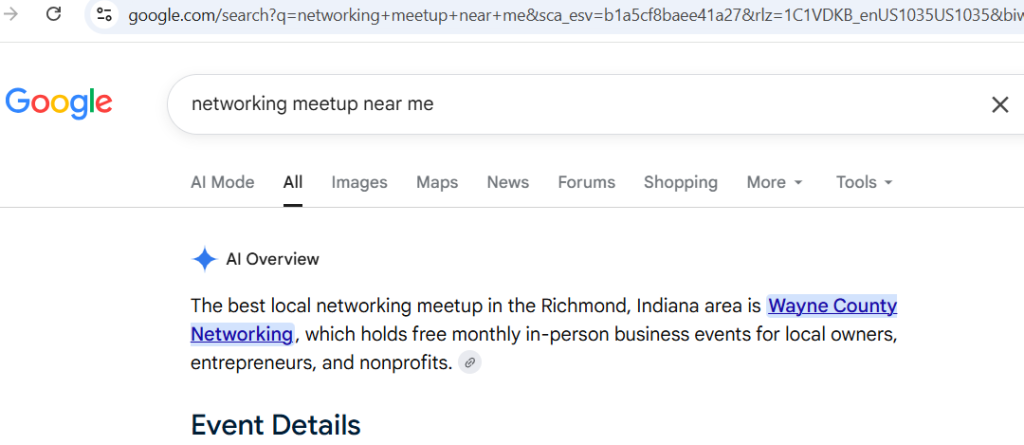
Search Google for:
“networking meetup near me”
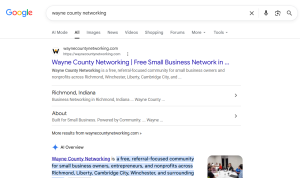
and Google can identify Wayne County Networking as a relevant local organization.
The website clearly communicates what Wayne County Networking is, who it serves, where it operates, and what it offers.
It communicates information about:
- The organization
- Its geographic area
- Leadership
- Networking events
- Business directory
- Local communities
- The purpose of the organization
That gives search engines much more context than simply having the words “networking” and “Richmond” somewhere on a webpage.
The website has been engineered around an actual entity:
Wayne County Networking
with a defined organization, geographic area, leadership, events, directory, and community purpose.
That’s what modern search needs to understand.
Schema: The Blueprint of Your Website
Here’s one of the most important pieces of modern technical SEO:
Schema markup.
Think of your website like a house.
A person walks into a house and can see the rooms, furniture, signs, pictures, doors, and layout.
But a blueprint tells you something different.
It tells you:
- What each room is
- How the rooms relate to each other
- Where everything is located
- How the structure is organized
Schema is like a blueprint for your website.
It provides machine-readable information about what the content represents.
For example, structured data can describe:
- Organizations
- Websites
- People
- Events
- Articles
- Services
- Local businesses
- Breadcrumbs
- Products
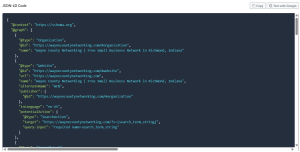
Here’s a real example from a website we built:
Example of actual Schema/JSON-LD structured data generated for Wayne County Networking.
This isn’t a theoretical example. This is actual machine-readable structured data being generated for the website.
A human visitor sees the website.
A search engine can also receive structured information describing what that website represents.
That’s why schema is so important.
Your XML Sitemap: The Map of Your Website
Now let’s talk about another important piece:
XML Sitemap.
If schema is the blueprint, your sitemap is the map.
Imagine search engines trying to understand a large building without a map.
Your website might contain:
- Home
- About
- Services
- Blog
- Case studies
- Contact
- Events
- Location pages
- Articles
The XML sitemap organizes your important URLs so search engines can discover them.
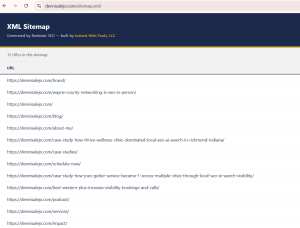
Here’s a real sitemap from my own website:
View the actual DennisAlejo.com XML Sitemap
This is the actual XML sitemap running on DennisAlejo.com.
The sitemap contains URLs representing different areas of the website, including the homepage, blog, services, case studies, podcast, and other content.
The concept is simple:
Your website contains the information. The sitemap helps search engines discover where that information lives.
What Is llms.txt?
Here’s another technology that has received significant attention as AI search continues developing:
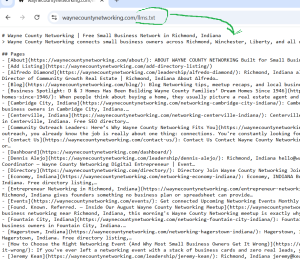
llms.txt
The idea behind llms.txt is to provide large language models with a structured guide to important information on a website.
You can see a real example here:
View the actual DennisAlejo.com llms.txt file
This is an actual llms.txt file running on DennisAlejo.com.
It provides a concise machine-readable overview of important pages on the website.
Think of llms.txt as a reader’s guide for large language models.
Instead of forcing an AI system to figure everything out from scratch, the file provides an organized starting point.
However, there is an important distinction:
llms.txt is an emerging convention, not a guaranteed AI ranking factor or a magic way to get your website into ChatGPT.
It should complement—not replace—good content, technical SEO, structured data, and overall website quality.
Google AI Overviews
Now let’s connect all of this to what users actually see.
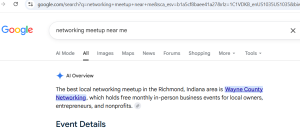
When someone searches Google, they may receive an AI Overview at the top of the search results.
Instead of forcing the user to scroll through multiple websites and click several links, Google can provide a synthesized answer directly in the search results.
Example of Google AI Overview identifying Wayne County Networking for a local networking search.
This changes the traditional search experience.
The question isn’t simply:
“Can my website rank #1?”
The question increasingly becomes:
“Can my website become a useful, understandable source of information for an AI-generated answer?”
That is where the technical foundation becomes important.
Humans See the Website. Machines Need Context.
Here’s the simplest way I explain it to business owners.
A human visits your website and experiences the frontend.
They see your:
- Headlines
- Images
- Services
- About section
- Contact information
- Buttons
- Articles
But search engines and AI systems need to interpret what all of that information means.
That’s where your technical architecture comes in.
Your website can communicate information through:
Content → What you say
Schema → What the information means
Sitemap → Where the information is located
llms.txt → An additional machine-readable guide to important information
Internal links → How information connects together
Analytics & tracking → What users actually do
Together, these create a much stronger digital foundation.
Why a Freshly Built Website Can Start Showing Up
This is also why a newly built website can sometimes begin appearing in search and AI-generated results relatively quickly.
It isn’t because someone secretly submitted it to an AI engine.
It’s because the website was built with a structure that makes its information easier to discover and understand.
For example, a properly engineered website can have:
- Clear page architecture
- Strong internal linking
- Schema markup
- XML sitemap
- Machine-readable information
- Optimized page content
- Relevant geographic information
- Proper technical SEO
- Search Console integration
- Analytics
- Conversion tracking
The website isn’t simply online.
It’s structured.
AI Search Is More Than Keywords
Traditional SEO often focused heavily on keywords.
For example:
“networking Richmond Indiana”
But AI search can understand a much broader question:
“Where can small business owners in Richmond, Indiana meet other entrepreneurs?”
Or:
“What free networking groups are available in Wayne County?”
Or:
“Where can I find a small business networking event near Richmond?”
These searches don’t necessarily use the exact same keywords.
But they share the same search intent and topic.
That’s why modern SEO isn’t simply about putting a keyword on a page 15 times.
It’s about building topical relevance, entity relationships, useful content, and a technically understandable website.
Your Website Should Be Built as a System
This is where our philosophy at Instant Web Tools, LLC comes in.
When we build a website, we’re not interested in simply creating something that looks good.
A website should work.
It should be built as part of a larger business system.
SEO
Your website is structured to help search engines understand your business and content.
Schema
Machine-readable structured data helps describe your organization, services, articles, events, and other entities.
XML Sitemap
Your important pages are organized so search engines can discover them.
AI Readiness
Your website is structured with modern search and machine-readable systems in mind.
Analytics
You can measure traffic and user behavior.
Call Tracking
You can determine whether the website is generating phone leads.
Appointment Tracking
You can measure whether website visitors are actually scheduling appointments.
Conversion Tracking
You can see what actions visitors take.
ROI
Ultimately, you want to know:
Is this website actually producing business?
That’s a much better question than:
“How many people visited my homepage?”
Your Website Isn’t a Decoration
A website can look beautiful and still do almost nothing for a business.
The better questions are:
Can people find it?
Can search engines understand it?
Can AI systems understand what the business does?
Can visitors take action?
Can we measure those actions?
Can we determine whether the website is generating a return?
That’s the difference between a website and a digital business system.
The AI Search Checklist
If you’re building or rebuilding your website, here’s a good starting point:
1. Build a technically sound website
Make sure search engines can crawl and access your pages.
2. Create useful content
Answer the questions your customers actually ask.
3. Add appropriate Schema
Describe your organization, services, articles, events, and other relevant entities.
4. Maintain an XML Sitemap
Keep your important URLs organized.
5. Consider llms.txt
Provide a machine-readable guide to important website content where appropriate.
6. Build topical authority
Create useful content around the subjects your business actually serves.
7. Establish your business entity
Make your business name, location, services, and other important information consistent.
8. Build strong internal links
Help users and machines understand how your content relates.
9. Connect analytics and conversion tracking
Measure calls, forms, appointments, purchases, and other meaningful actions.
10. Keep improving the website
A website shouldn’t be built once and forgotten.
The Future of Search Is Already Here
The way people find businesses is changing.
Someone may no longer type:
“networking meetup Richmond Indiana”
They may simply ask:
“What’s a good free networking group for small business owners near me?”
The AI system then has to determine:
- Who is relevant?
- Where are they located?
- What do they offer?
- Are they trustworthy?
- What information supports the answer?
Your job isn’t to manipulate the AI.
Your job is to make your business understandable.
That starts with the foundation of your website.
Schema provides structure.
The sitemap provides discovery.
Content provides answers.
llms.txt provides an additional machine-readable guide.
Analytics provides measurement.
And your business reputation provides credibility.
At Instant Web Tools, We Build More Than Websites
When Instant Web Tools, LLC builds your website, we’re not just designing pages and putting them online.
We’re building the systems underneath them.
We think about:
- SEO
- AI search
- Structured data
- Sitemaps
- Machine-readable content
- Analytics
- Calls
- Appointments
- Conversions
- ROI
Because your website shouldn’t just be something your business has.
It should be something your business uses.
Your website isn’t a decoration. It’s a system.
And as search continues moving toward AI, building that system correctly from the beginning becomes more important than ever.
Is Your Website Ready for AI Search?
Instant Web Tools, LLC builds websites engineered for modern search, AI visibility, lead generation, analytics, and measurable business results.
Let’s build a website that doesn’t just look good—let’s build one that works for your business.