
Last updated: November 17, 2026
If you received an email from a Gmail, Yahoo or AOL address claiming to be me or Instant Web Tools, it is fake. My official email addresses end in @iwt.one. I never send business requests or invoices from free email accounts.
I want to bring an important matter to the attention of my friends, professional network, clients and community. Scammers are sending emails that pretend to come from me and my company. This page explains what is happening, how to recognize these emails, and what to do if you received one.
What’s happening
People are sending emails that impersonate me and my company, Instant Web Tools, LLC. They use my name, my photo, and my company information to make the messages look real. So far, more than ten people in my network have reported these emails, sent from several different Gmail, Yahoo and AOL accounts and written in different formats.
These emails do not come from me, my team, or any account I control. Nobody is authorized to contact you on my behalf from these addresses.
I’m concerned these messages may be going out much more widely than my own network, so I’m publishing this notice to make sure anyone who searches my name finds the truth.
Known fraudulent email addresses
Do not trust any message from these addresses:
- dennis.instantwebtools@gmail.com
- dennisalejo.instantwebtools@aol.com
- dennis.instantwebtoolsllc@yahoo.com
This list will be updated as new addresses are reported. Scammers often create new accounts once old ones are shut down, so a message from an address not on this list can still be fake. The rule is simple: if it doesn’t end in @iwt.one, it’s not from me.
What the fake emails look like
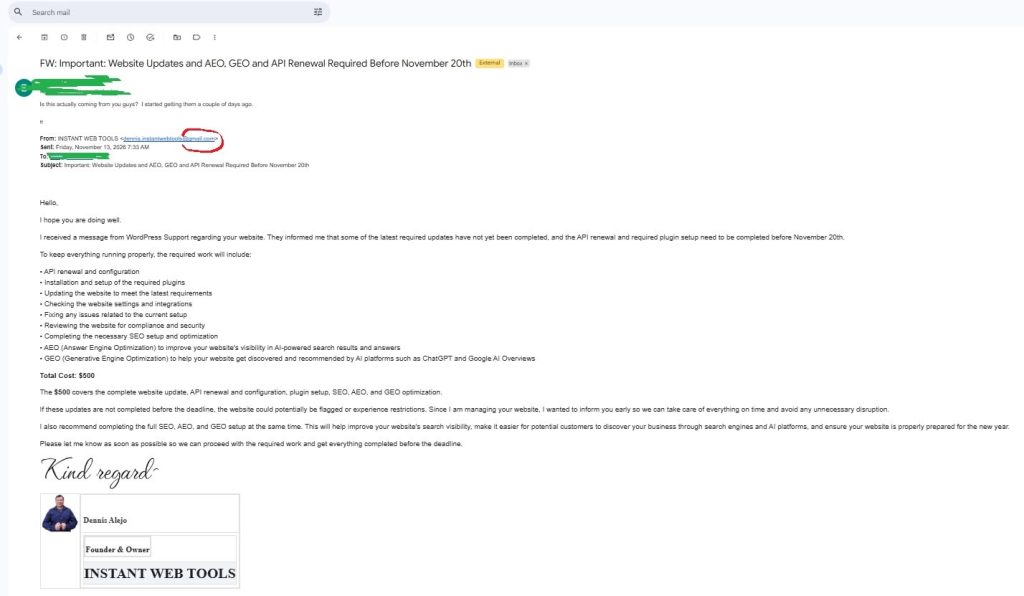
One common version has the subject line “Important: Website Updates and AEO, GEO and API Renewal Required Before November 20th.” It claims that:
- “WordPress Support” contacted me about your website.
- An “API renewal” and “required plugin setup” must be finished before a deadline.
- Your website “could potentially be flagged or experience restrictions” if the work isn’t done.
- The total cost is $500 for updates, SEO, AEO (Answer Engine Optimization) and GEO (Generative Engine Optimization).
The email is signed with my name, “Founder & Owner, Instant Web Tools,” and sometimes includes my real photo copied from the internet.
None of this is real. WordPress does not send deadlines like this, there is no “API renewal,” and I would never ask anyone for payment this way.
How this scam works
These emails usually don’t include a payment link at first. That’s on purpose. The scam works in steps:
- The bait. A plain-text email with no links slips past spam filters and looks like a normal business message.
- The reply. The email asks you to “let me know as soon as possible.” Replying tells the scammer your address is real and that you’re interested.
- The payment request. After you reply, they send a fake invoice, a payment link, or a request for Zelle, wire transfer, gift cards or cryptocurrency, which are hard to reverse.
- Follow-ups. If you don’t answer, they keep sending new versions, sometimes from new addresses.
Some versions may also include attachments or links to fake login pages designed to steal passwords.
Red flags to watch for
- The sender’s address is Gmail, Yahoo, AOL or another free email service, even though the name says “Instant Web Tools.”
- The message mentions a vague outside authority, like “WordPress Support said…”
- There’s a hard deadline and a warning about what happens if you miss it.
- It asks for payment or personal information by email.
- It says nothing specific about your actual account or website.
- It pushes you to act quickly instead of calling to confirm.
How to check who really sent an email
Scammers can type any name they want into the “From” field. What they can’t fake as easily is the actual email address behind it. Always check it:
- On a computer: hover over or click the sender’s name to see the full address.
- On a phone: tap the sender’s name at the top of the email. The full address appears under it.
If the name says “Dennis Alejo” or “Instant Web Tools” but the address doesn’t end in @iwt.one, it’s fake.
What you should do
- Do not reply, pay, click links or open attachments.
- If you already replied, don’t send any payment or open anything they send back. Contact me directly.
- If you already paid, call your bank or card company right away and ask them to stop or reverse the payment. Then file a report at ic3.gov.
- If you entered a password on a page they sent you, change that password immediately and turn on two-step verification.
- Forward the email to dennis@iwt.one, as an attachment if you can, so the technical headers are included. I’m collecting every report for the authorities and email providers.
- When in doubt, verify. Contact me through the information on my official websites below, never through contact details in a suspicious email.
How to report the email
Reporting helps get these accounts shut down faster:
- In your email app: use “Report phishing” or “Report spam.” This trains your email provider’s filters to catch the next one.
- Gmail addresses: report the sender to Google through Gmail’s abuse reporting form.
- Yahoo and AOL addresses: report the sender through Yahoo’s and AOL’s abuse and phishing reporting pages.
- FBI Internet Crime Complaint Center:ic3.gov, especially if you lost money.
- Federal Trade Commission:ReportFraud.ftc.gov
Be careful with any website or person that promises to “recover” your money or “catch” the scammer for a fee. Fake recovery services are a common second scam aimed at people who were just scammed.
Frequently asked questions
Is this email really from Dennis Alejo or Instant Web Tools?
No. Any email claiming to be from me that doesn’t come from an @iwt.one address is not from me.
How did the scammers get my email address?
Scammers don’t need to hack anyone to do this. Many email addresses are public, listed on business websites, social media profiles and online directories. There are tools that collect these addresses in bulk from websites and social media. That’s likely why so many people in my personal and professional network received these messages.
Is my website in danger?
These emails are a payment scam. Receiving one does not affect your website. You don’t need to do anything other than ignore, report and delete the message. If you replied, clicked a link or entered a password, contact me so we can help.
Will Dennis ever ask me to pay by email?
I will never ask for payment from a Gmail, Yahoo or AOL account, and I will never pressure you with a deadline or a threat. If you ever get a payment request that seems unusual, contact me through my official channels before you pay.
I’m not sure if a message is real. What should I do?
Don’t reply to it. Contact me separately using the information on my official websites, and I’ll confirm whether it came from me.
My official websites
For accurate information about me and my work, please use only these websites:
- Personal: dennisalejo.com
- Instant Web Tools: instantwebtools.co
- Alejo Press: alejo.press
- Kingdom Legacy Ministries: [ADD KLM WEBSITE]
A note for other business owners
If you run a business with a public name and online presence, this can happen to you too. A few steps can make you harder to impersonate:
- Use an email address on your own business domain, never a free email account, so customers learn what your real messages look like.
- Ask your web provider to set up SPF, DKIM and DMARC on your domain so others can’t easily send email that looks like it’s from you.
- Tell your customers exactly how you send invoices and how to verify a payment request.
- Turn on two-step verification for your email, social media and website logins.
- Limit who can see your email address on LinkedIn and Facebook.
- If it happens, warn people quickly and publicly, and post the truth where they’ll find it when they search your name.
What I’m doing
Every reported address is being reported to Google, Yahoo and AOL and to the FBI’s Internet Crime Complaint Center. I’m keeping records of every report, including dates, addresses and message content.
Please don’t publicly accuse anyone or guess who is behind this. This is being handled through evidence and the proper reporting channels.
A personal note
Over the years, I’ve worked hard to build my businesses, relationships and reputation. I understand that trust isn’t built overnight, and I never take it for granted.
I can’t control how others misuse my name, but I can control how I respond. My commitment stays the same: to serve people honestly, do business with integrity, and keep doing meaningful work through my businesses and community initiatives.
Thank you to everyone who reached out to check, shared information, and helped protect others. You did exactly the right thing.
Verify before you trust. And when in doubt, contact me through my official channels.
Dennis Alejo
Founder & CEO, Instant Web Tools, LLC
Co-founder, Kingdom Legacy Ministries
dennis@iwt.one · dennisalejo.com
For the full story and more tips on protecting yourself online, read: Someone Is Impersonating Me: What to Do When Criminals Use Your Name